
Medium Dress Size in Number
In US women’s sizing, a medium usually corresponds to a dress size 8–10. Use the converter to translate any letter size into numeric sizes for the US, UK, Europe, Australia and Italy — or enter your measurements to find your likely size, then compare with the brand’s own chart.
- Free to use
- No sign-up
- Runs in your browser

Dress size converter
Find my size from measurements
Dress Size Conversion & Measurement Kit
Printable international dress size chart, a personal measurement card, a brand-by-brand size tracker and a garment measurement worksheet.
- International size chart (PDF, XLSX)
- Measurement card (PDF, DOCX)
- Brand size tracker (XLSX, PDF)
- Garment vs body worksheet (XLSX, PDF)
Formats: PDF, XLSX, DOCX. Instant download after payment (link valid 72 hours, up to 5 downloads). AI-assisted: the templates were drafted with AI help and reviewed and laid out before publishing.
$3.00 USD, one-time 4 files · about $0.75 each
- Instant download
- 7-day refund
- Secure checkout by Stripe
7-day money-back guarantee. Full refund within 7 days of purchase, even after you download.
Free sample: Brand Size Tracker (PDF, 45 KB)
Full refund within 7 days — see the refund policy and license.
Free printables
Single sheets you can print right now, no sign-up. The full pack adds every sheet in one download plus the editable files.
 Garment vs Body Measurement Worksheet
What number is a medium dress size?
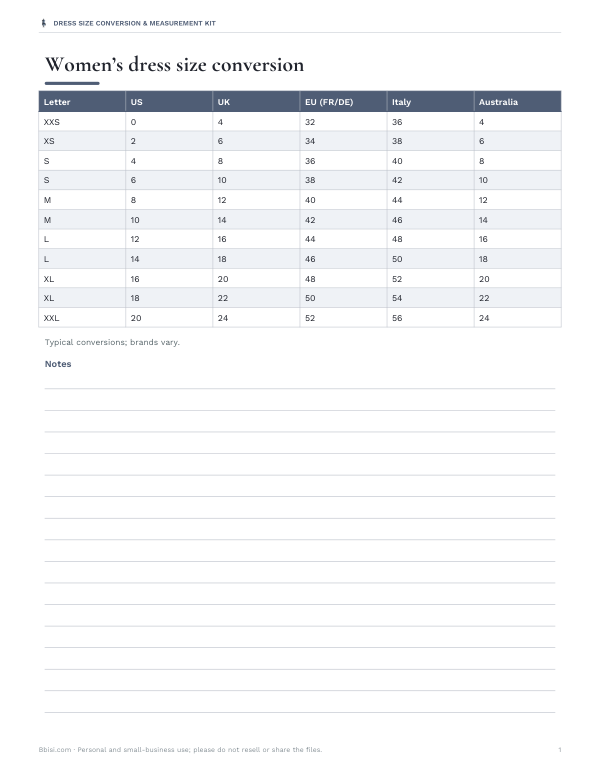
In most US women’s (misses) sizing, a medium is a dress size 8 or 10. A small is usually 4–6 and a large 12–14. In the UK, the same medium is a size 12–14; in France and Germany a 40–42; in Italy a 44–46; and in Australia a 12–14. These are typical conversions — there is no legal standard for clothing sizes in the US, and each brand sets its own measurements, so a medium in one label can be closer to a size 6 or a size 12 in another.
Letter to number size chart
| Letter | US | UK | EU (FR/DE) | Italy | Australia |
|---|---|---|---|---|---|
| XXS | 0 | 4 | 32 | 36 | 4 |
| XS | 2 | 6 | 34 | 38 | 6 |
| S | 4–6 | 8–10 | 36–38 | 40–42 | 8–10 |
| M | 8–10 | 12–14 | 40–42 | 44–46 | 12–14 |
| L | 12–14 | 16–18 | 44–46 | 48–50 | 16–18 |
| XL | 16–18 | 20–22 | 48–50 | 52–54 | 20–22 |
| XXL | 20 | 24 | 52 | 56 | 24 |
Rule of thumb: UK and Australian sizes are about 4 higher than US sizes, French and German sizes about 32 higher, and Italian sizes about 36 higher.
Typical measurements for a medium
| US size | Bust | Waist | Hips |
|---|---|---|---|
| 8 (M) | 35–35.5 in (89–90 cm) | 27.5–28 in (70–71 cm) | 37.5–38 in (95–97 cm) |
| 10 (M) | 36–36.5 in (91–93 cm) | 28.5–29 in (72–74 cm) | 38.5–39 in (98–99 cm) |
These are typical body measurements used by many US brands for misses sizing, not garment measurements. Garments include ease — extra room for movement — that varies by style: a fitted sheath dress has little ease, a shift or wrap dress much more.
How to measure yourself
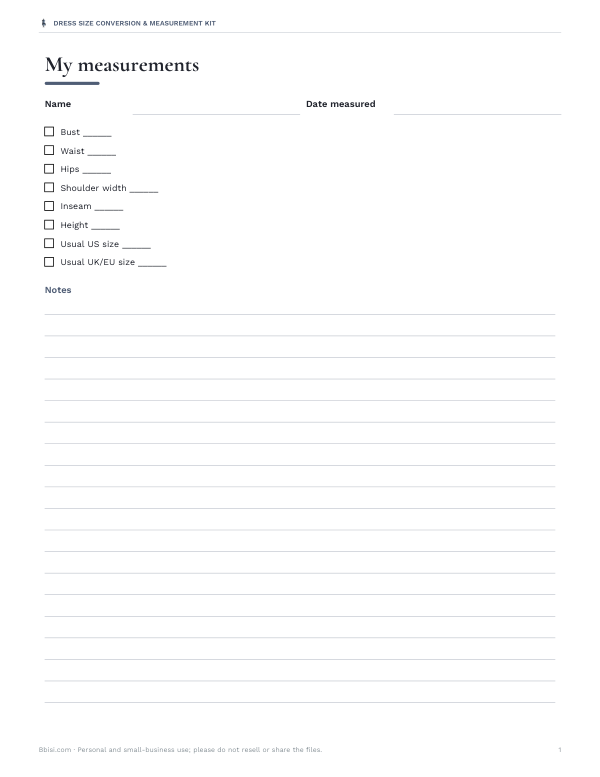
- Bust — around the fullest part of the chest, tape level across the back, wearing a non-padded bra.
- Waist — around the natural waist, the narrowest part of the torso, usually just above the belly button.
- Hips — around the fullest part of the hips and seat, feet together.
- Keep the tape snug but not tight and breathe normally.
- Measure in inches or centimetres and write the numbers down.
If your measurements fall in different sizes, choose the size for the part the dress fits most closely. For a fitted bodice with a full skirt, choose by bust and waist; for a straight or pencil dress, by hips.
Why dress sizes vary so much
- No mandatory standard — US sizes are guided by voluntary industry standards, and brands adapt them to their customers.
- Vanity sizing — over decades, many brands have labelled larger measurements with smaller numbers.
- Different fit models — each brand designs around its own reference body.
- Size ranges — petite, tall, plus and junior sizes use different number systems (for example, junior sizes are odd numbers such as 5, 7, 9).
- Style and fabric — stretch fabrics and relaxed cuts fit a wider range of bodies.
Petite, plus and junior sizes
Petite sizes (P, such as 8P) are designed for women about 5 ft 4 in (163 cm) and under, with shorter lengths and proportions. Plus sizes use numbers such as 14W–24W or 1X–4X, with different proportions from misses sizes of the same number. Junior sizes (1, 3, 5, 7…) are cut for a straighter, younger figure. A medium in misses sizing is therefore not the same as a medium in plus or junior ranges.
Worked example
Someone with a 36 in bust, 28 in waist and 38.5 in hips checks the converter: bust suggests US 10, waist US 8 and hips US 10. For a fitted dress they choose the larger size, a US 10 (a medium), which is a UK 14, EU 42, Italian 46 and Australian 14. For a stretchy wrap dress, a US 8 might also fit. They then check the brand’s chart, which lists its medium as bust 35.5–37 in, confirming the choice.
Dresses from different countries
European and UK brands often label dresses with a single numeric size, and some list two systems on the label, such as “UK 12 / EU 40 / US 8”. Asian brands may use smaller measurements for the same letter size, so an Asian medium can fit like a US small — check the centimetre chart rather than relying on the letter. When a brand gives only one system, convert with the chart above and then confirm with the brand’s measurements, because conversions between systems are approximate and brands round differently.
Shopping tips
- Keep your measurements on your phone and compare with each brand’s chart.
- Read reviews for comments such as “runs small” or “size up”.
- Check the garment measurements on product pages when available.
- For online orders, check the return policy before buying two sizes.
- Consider alterations: taking in is easier than letting out.
Frequently asked questions
What size number is a medium?
Typically US 8–10 in women’s misses sizing.
Is a medium a 10 or a 12?
Usually 8–10 in the US. A UK 12 is a US 8.
What is a medium in UK sizes?
About UK 12–14.
What is a medium in European sizes?
About EU 40–42 (French/German).
Is size 6 small or medium?
Usually small; medium starts around size 8.
What is a medium in Italian sizes?
Usually an Italian 44–46.
Is a medium the same in tops and dresses?
Usually similar, but tops are sized mainly by bust and dresses by bust, waist and hips together, so your dress size may differ.
Are these conversions exact?
No. They are typical; always check the brand’s own size chart.